

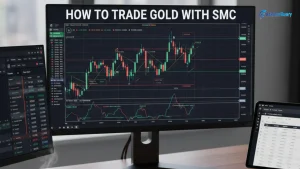
Gold is a powerful asset in the forex market. Traders call it XAU/USD. It moves fast and can be dangerous for new traders. Many people use old tools that do not work well. Professional traders use Smart Money Concepts (SMC) instead.
This post shows you how to trade gold using logic from big banks. We will look at liquidity, market structure and entry zones.
What are Smart Money Concepts (SMC)?
SMC is a way to read the market. It assumes that big banks and hedge funds move the price. These players leave footprints on the chart. SMC helps you find these marks. You can trade with the big money instead of against it.
Why SMC Works for Gold Trading
Gold price often traps retail traders. Banks “sweep” prices to hit stop losses. This gives the banks the orders they need to move the market. SMC helps you see these traps before they happen. You will learn to wait for the banks to move first.
Core SMC Pillars for Gold
You must learn four main ideas to trade gold like a pro.
- Market Structure and Order Flow
Gold trends very hard. You must find the trend on a high timeframe. Use the 4-hour or Daily chart.
- BOS (Break of Structure): This means the trend is continuing.
- CHoCH (Change of Character): This is the first sign that the trend might end.
- Liquidity (The Market Fuel)
Price moves to find money. In trading, money is at the stop losses of other traders. On gold charts, liquidity sits at certain spots:
- Highs and lows from the day before.
- Equal highs and equal lows.
- Highs and lows from the Asian session.
- Fair Value Gaps (FVG)
When gold moves fast, it leaves a gap. This is called an imbalance or a Fair Value Gap. Price usually comes back to fill these gaps later. This is a great place to look for a trade.
- Order Blocks (OB)
An Order Block is a candle where big banks placed orders. In a buy trend, it is the last down candle before a big move up. These zones act like magnets for the price.
Understanding Premium and Discount Zones
You should not buy gold when it is expensive. You should not sell it when it is cheap. Professional traders use a tool to find the middle of a move. This is the 50% mark.
- Discount Zone: This is below the 50% mark. This is where you look for buys.
- Premium Zone: This is above the 50% mark. This is where you look for sells.
Wait for gold to pull back into these zones. If you buy in a discount zone, you have more room for profit.
Common Retail Traps on Gold
Gold is famous for tricking people. You must know these traps to stay safe.
The Double Top Trap
Retail traders see two highs and think the price will drop. They sell and put their stops just above the highs. Banks know this. They push price up to hit those stops. Then they sell at a better price.
The Support Break Trap
Traders see a support line break and sell right away. This is often a “fake out.” The price breaks the line only to grab money. Then it zooms back in the other direction. Always wait for a shift in structure before you enter.
Step-by-Step Strategy: The “Sweep and Shift” Model
This is a simple plan for the gold market.
Step 1: Find the High Timeframe Trend
Look at the Daily chart. Is gold making higher highs? If yes, only look for buys. If it makes lower lows, only look for sells. Do not fight the big trend.
Step 2: Watch the Clock
Gold moves most during the London and New York sessions.
- London: 2:00 AM to 5:00 AM EST.
- New York: 7:00 AM to 10:00 AM EST.
Do not trade gold during the Asian session. The volume is too low then.
Step 3: Wait for a Liquidity Sweep
Wait for the price to break a previous high or low. This is the “trap.” It looks like a breakout, but it is often just a hunt for stop losses.
Step 4: Look for a Shift
Once the trap is set, look at the 1-minute or 5-minute chart. Wait for a CHoCH. You want to see a fast move in the new direction. This move should leave a Fair Value Gap.
Step 5: Set the Entry
Place your trade at the start of the Fair Value Gap.
- Stop Loss: Put it below the low that swept the liquidity.
- Target: Aim for the next major high or low on the chart.
A Real Example of a Gold Trade
Let us look at a buy trade on XAU/USD.
- The 4-hour trend is up.
- During the London session, gold drops below the Asian session low.
- This is a liquidity sweep.
- On the 1-minute chart, gold breaks a small high. This is our CHoCH.
- A large green candle leaves a gap (FVG).
- We set a buy order at that gap.
- Price hits the order and then moves up to the New York high.
This trade works because we followed the trend and the clock.
Gold-Specific Tips for Success
Gold moves differently than currency.
- Check the US Dollar (DXY): Gold and the Dollar usually move in opposite ways. If the Dollar is weak, gold is often strong.
- Handle News with Care: High-impact news like CPI or NFP makes gold move hundreds of pips. Do not guess where it will go. Wait for the dust to settle before you enter.
- Use a Small Size: Gold pips are worth a lot of money. A small move can hurt your account if your lot size is too big. Only risk 1% of your money on one trade.
Psychology of Gold Trading
Gold is volatile. It can be scary to watch. You must stay calm and follow your plan. If you miss a trade, do not chase it. The market always gives another chance. Stick to your rules and manage your risk every day.
Many traders fail because they get greedy. They see gold moving fast and want to get rich quick. This leads to big losses. You must think like a business person. Protect your capital first.

Understanding Institutional Logic
Big players need to buy when others are selling. They need to sell when others are buying. This is why they create “fake” moves. They want to trick retail traders. When you see a “double top,” do not just sell. Wait for the price to go above that top and then fail. That is where the real move starts.
Banks use “Inducements” to get you to enter early. An inducement is a small move that looks like a trend. It lures you in so the banks can use your stop loss as liquidity. Patience is your best friend.
Advanced Confluence Factors
To make your trades better, use more than one reason to enter.
- Does the Order Block line up with an FVG?
- Is the price at a “discount” or “premium” level?
- Is the move happening at a Kill Zone time?
When three or more things line up, the trade has a higher chance to win.
Glossary of SMC Terms for Gold
- Liquidity: Areas on the chart where many stop losses are placed.
- Mitigation: When price returns to an Order Block to “close” old bank orders.
- Inducement: A trap set to make you trade too early.
- Displacement: A very strong move that shows the banks are active.
Key Tips for Successful Gold Traders
Here are some extra tips to keep you safe and profitable:
- Always wait for a candle to close before you make a choice.
- Focus on one pair like XAU/USD to learn its unique habits.
- Mark your zones on the 15-minute chart for better precision.
- Look for “Inducement” highs that sit just below a major Order Block.
- Take partial profits at the first sign of a structure shift.
- Keep a trading journal to track which SMC setups work best for you.
- Never move your stop loss to avoid a loss; trust your plan.
Conclusion
Trading gold with SMC is about patience. You are waiting for the “Smart Money” to show their hand. Wait for the sweep. Watch for the shift. Enter on the gap. This method keeps you on the right side of the market.
Practice these steps on a demo account first. Once you see the patterns, you can trade with real confidence. Gold rewards those who wait for the right setup.
Disclaimer: Trading involves significant risk. This post is for educational purposes and does not constitute financial advice.














. Master XAU/USD market structure, liquidity sweeps, and fair value gaps)