

In the post-pandemic era, availability of medical oxygen at home is no longer a mere luxury; this is an important part of emergency preparedness. Whether you’re managing a chronic illness like COPD or looking for a protective cover for an elderly member of the family, it can be challenging to find the right equipment in the Indian medical equipment market.
From busy medical hubs in Delhi to specialist suppliers in Mumbai, the price of oxygen cylinder price keeps fluctuating depending on the material, capacity and technology. This guide provides you with all the necessary information about buying, renting and taking care of an oxygen cylinder.
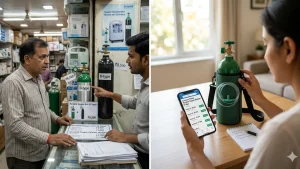
Quick Summary: Market Highlights at a Glance
If you’re in a hurry, here are the main price ranges:
- Economical beginning: The portable oxygen can for the trip ranges from ₹450 to ₹900.
- Most Popular Choice: The 10-liter “B-Type” steel cylinder typically costs between ₹11,500 and ₹17,500.
- Premium Mobility: Lightweight aluminum portable kits (OxyKit) range from ₹18,000 to ₹28,000.
- Refill Economics: Standard refills for medium tanks are priced between ₹1,400 and ₹2,800.
-
Why Material Matters: Steel vs. Aluminum
The single biggest factor affecting the oxygen cylinder price, aside from size; is the metal used to build the tank.
High-Strength Seamless Steel (The Budget Workhorse)
Steel cylinders are the most common in Indian hospitals and for home backup. These tanks are extremely durable and can withstand high pressure for decades. However, they are quite heavy. A 10-liter steel tank can be heavier than 14 kg even when empty.
- Price Range: 10L tank price approx ₹9,500 – ₹13,500.
- Best For: For stationary use in the house where the tank remains in the same room.
Specialized Aluminum Alloy (The Mobility King)
Aluminum tanks are roughly 30% to 40% lighter than steel. They are also naturally resistant to internal corrosion, ensuring the gas remains ultra-pure. Because they are non-magnetic, they are the only choice for use near MRI machines.
- Price Range: ₹18,000 – ₹32,000 for portable kits.
- Best For: Active patients, travel, and emergency transport.
-
Breaking Down the Costs by Cylinder Type
Tanks in the Indian market are classified into “types” (A, B, C, D) based on their water capacity and volume of gas.
Portable Oxygen Kits (Type-A & 2.2L – 4.5L)
These are designed for the “patient on the go.” They usually come in a shoulder bag with a pre-fitted regulator.
- Typical Price: ₹14,000 – ₹22,000.
- Duration: 2 to 4 hours at a flow rate of 2 LPM.
- Key Advantage: Fits in a car seat or under an airplane seat (check airline policy).
Standard Home Units (Type-B & 10-Liter)
The “B-Type” is the gold standard for home care. It provides enough oxygen to last through a long power cut or an overnight transition.
- Typical Price: ₹11,500 – ₹17,000 (Full Kit).
- Duration: 8 to 12 hours at 2 LPM.
- Key Advantage: Highly stable and easily refillable at any local gas station.
Jumbo/Stationary Tanks (Type-D & 46.7-Liter)
These are massive tanks, standing about 4.5 to 5 feet tall. You will see these in clinics or used as a primary source for patients requiring high-flow oxygen.
- Typical Price: ₹45,000 – ₹65,000.
- Duration: 50+ hours at 2 LPM.
- Key Advantage: Lowest cost per liter of gas; ideal for remote areas where refills are hard to get.
Pro-Tips for the Smart Buyer
Before you swipe your card, keep these catchy tips in mind to avoid common “medical gear” traps:
- Don’t “Tank” Your Budget: A cheap cylinder without a regulator is useless. Always ask if the price includes the Fine Adjustment Valve (FAV) and a Humidifier Bottle.
- Look for the “ISI” Mark: In India, medical gas cylinders are mandated to be certified by the Bureau of Indian Standards (BIS) and approved by PESO (Petroleum and Explosives Safety Organization). It is forbidden to buy without a mark!
- The Weight Test: If you can’t lift the “portable” tank with one hand, then it is not portable for you. Be sure to check the weight before you buy.
- Refill Availability: Check if there is any refueling station within a radius of 10 km from your house. If you can’t fill the tank, an expensive tank will become just a stand of paper.
- Date of Manufacture: Cylinders are required to be hydro-tested every 5 years. look at the seal on the neck of the bottle; If it is more than 3 years old, you will have to pay for testing soon.
-
The “Hidden” Costs: Regulators and Accessories
When people search for the oxygen cylinder price, they often forget the accessories that enable the system to work.
| Accessory | Purpose | Estimated Cost (INR) |
| Click-Style Regulator | Controls the flow precisely (LPM) | ₹3,500 – ₹6,500 |
| Humidifier Bottle | Prevents the nose/throat from drying out | ₹450 – ₹950 |
| Nasal Cannula | The tube that delivers air to the nose | ₹150 – ₹350 |
| Cylinder Trolley | Allows you to wheel heavy steel tanks | ₹1,500 – ₹3,500 |
| Finger Pulse Oximeter | Vital to monitor if the oxygen is working | ₹900 – ₹2,500 |
-
Refilling and Maintenance
The initial purchase is a one-time investment, but the “running cost” is the gas itself.
- Refill Prices: Expect to pay ₹1,400 to ₹2,800 for a B-Type (10L) refill. Jumbo D-Type refills cost significantly more due to volume, often around ₹4,500 to ₹7,000.
- Home Delivery: Many vendors in cities like Delhi, Bengaluru, and Hyderabad offer doorstep “Swap and Go” services. This usually adds a delivery fee of ₹500 to ₹1,000 but saves you the hassle of transporting heavy tanks.
- Valve Maintenance: Every few months, check the “O-ring” in your regulator. A worn-out ₹50 rubber ring can cause a leak that empties your expensive tank overnight.
-
Renting vs. Buying: Which is Better?
If the oxygen cylinder price of ₹15,000 seems too high for a short-term recovery (e.g., post-surgery), renting is a viable alternative.
- Rental Deposit: Usually a refundable amount of ₹5,000 – ₹10,000.
- Monthly Rent: ₹1,900 – ₹3,800 per month.
- The Math: If the patient needs oxygen for more than 4 months, buying a new unit is almost always cheaper than renting.
Safety Checklist: Protecting Your Home
Oxygen is a “fire accelerant.” While it doesn’t explode on its own, it makes everything else burn with terrifying speed.
- The 5-Foot Rule: Keep the tank at least 5 feet away from gas stoves, candles, incense sticks and heaters.
- No Oil/Grease: Never use oily lotions or Vaseline on your face while using oxygen. High-pressure oxygen can react violently with oils.
- Ventilation: Never store a cylinder in a closed cupboard or a car trunk for long periods. Small leaks can build up oxygen levels, making the area a fire hazard.
- No Smoking: This is the #1 cause of home oxygen accidents. Post a “No Smoking” sign in the patient’s room.
-
Where to Buy (Trusted Brand)
You have three main avenues for purchase:
- Authorized Medical Dealers: Best for localized service and setup training. They often handle the PESO paperwork for you.
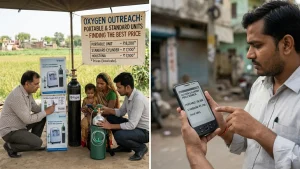
- Online Marketplaces (IndiaMART/Amazon): Good for comparing the oxygen cylinder price quickly. Ensure the seller provides a “Test Certificate.”
- Direct from Manufacturers: Brands like EKC (Everest Kanto Cylinder) or Rama are industry leaders in India. Buying their tanks ensures long-term reliability.
Final Verdict
Choosing the right oxygen cylinder is about balancing portability, duration, and price.
- For emergency backup at home: Buy a 10L B-Type Steel Cylinder (approx. ₹13,000).
- For active life and travel: Invest in a 2.2L Aluminum OxyKit (approx. ₹19,500).
- For chronic, high-flow needs: Consider an Oxygen Concentrator instead (prices start at ₹35,000, but no refills are needed).
By understanding the current market rates in INR, you can secure the best care for your loved ones without overpaying. Always consult with a pulmonologist to determine the exact flow rate (LPM) required before making your final purchase.